Severe drought conditions are intensifying across several regions of Somalia, causing
widespread livestock deaths and growing hardship among vulnerable communities,
according to reports from affected areas.
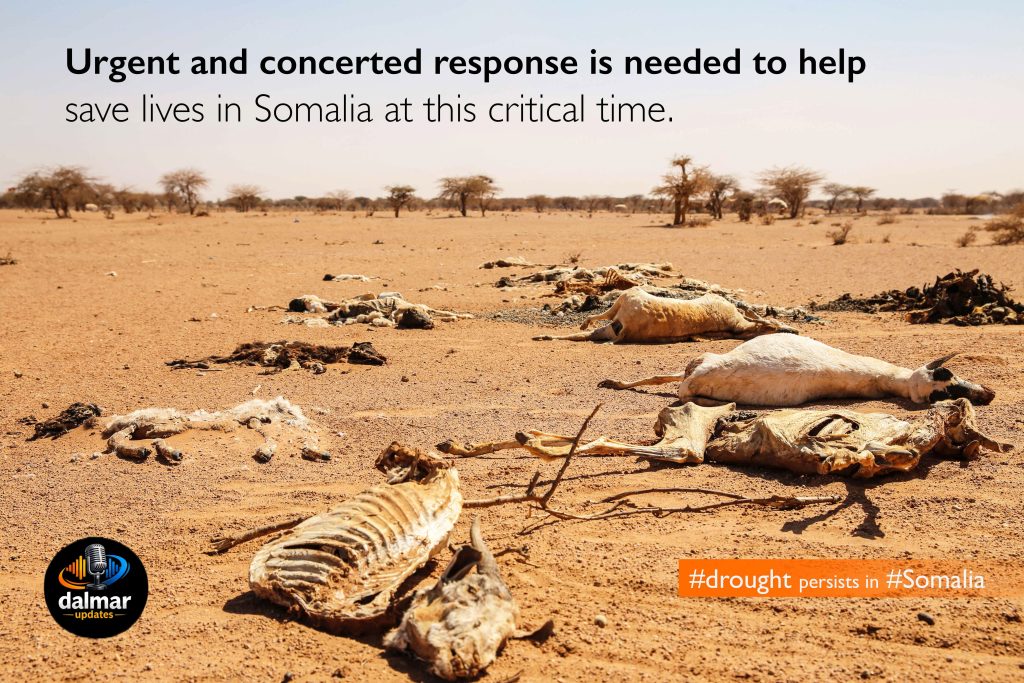
Local sources say the drought has led to the loss of large numbers of livestock,
although the exact scale of the deaths has yet to be confirmed.
The situation has also triggered serious humanitarian challenges,
particularly for pastoralists and farmers who depend almost entirely on rainfall for their livelihoods.
The worst-affected area is Lower Jubba region, under the administration of Jubaland,
where drought conditions have had a devastating impact on nomadic herders and farming communities.
Many pastoralists have reportedly lost up to half of their livestock,
while some farmers say they have not harvested any crops for the past two years due to prolonged rainfall failure.
Residents in the region are now forced to purchase water delivered by tanker trucks on a daily basis.
The price of a single barrel of water has risen to $7, up from $5 just weeks ago,
placing an additional financial burden on already struggling households.
The drought is not limited to Lower Jubba alone.
Severe conditions have also been reported in regions that lack access to Somalia’s two main rivers,
the Jubba and Shabelle, including Mudug, Bay, Bakool, Northeastern Somalia, and parts of Hirshabelle state.
Limited Government ResponseCritics say the Federal Government of Somalia—
has so far failed to publicly address the worsening drought or outline a clear response plan to support affected communities.
The Somali Disaster Management Agency (SoDMA), which is responsible for coordinating drought relief efforts,
has also faced allegations of widespread corruption.
Critics claim mismanagement and misuse of resources intended for vulnerable populations have further weakened the humanitarian response.
Regional Administrations StruggleRegional states are also facing significant challenges:
Jubaland is reported to be the hardest-hit region, while ongoing political tensions with the federal government have reportedly prevented budgetary support from reaching the administration.
Hirshabelle, which is also experiencing severe drought, is among the regions receiving limited financial assistance from both the federal government and international partners.
Northeastern Somalia, recently recognized by the federal government as a regional
administration, is facing acute drought affecting both people and livestock.
Bay, Bakool, and Mudug regions are like wise suffering from drought conditions and are reported to be receiving little to no drought relief or administrative support.
Humanitarian observers warn that without urgent intervention, the situation could deteriorate further,
increasing the risk of displacement, food insecurity, and loss of livelihoods across large parts of the country.
About the Author

Discover more from
Subscribe to get the latest posts sent to your email.